I’ve been covering Hyrule’s engineering renaissance since before the ink dried on Tears of the Kingdom’s first sales reports, and even in 2026 the community’s creative engine shows no signs of sputtering. The latest jaw-dropper comes from Reddit user osh-kosh-ganache, who has built a walking, laser-breathing Godzilla that feels less like a machine and more like a kaiju that accidentally swallowed a Zonai forge.
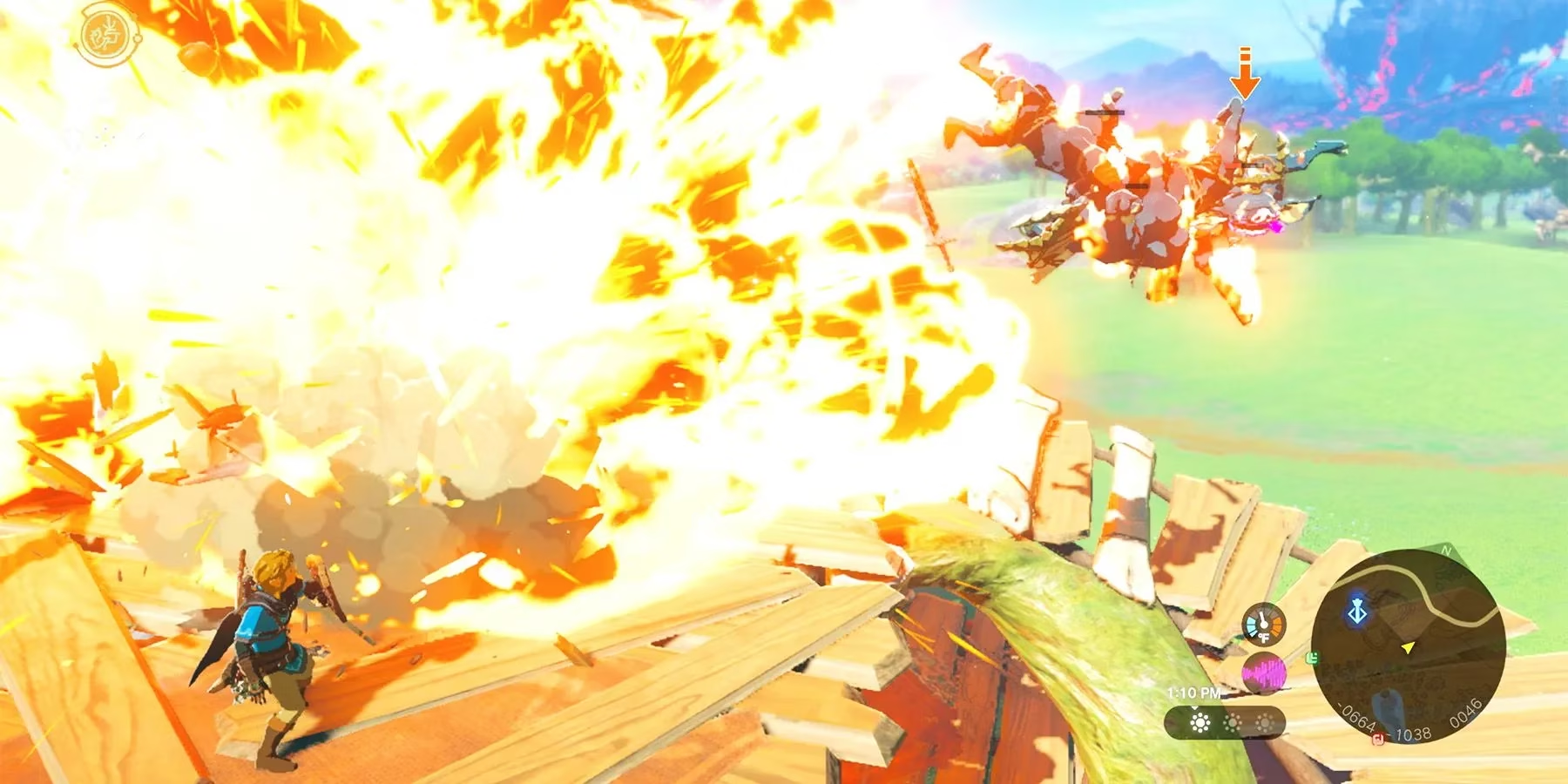
From a distance, the silhouette is unmistakable—a hunched, bipedal behemoth stomping through the Depths with a gait that mimics the iconic movie monster. What truly floored me, however, wasn’t the looks but how the thing delivers its payload. Imagine a dragon whose roar is replaced by a surgical laser barrage. The clip osh-kosh-ganache shared splits open an enemy camp like a razor through silk; the first shot flings Bokoblins into the air, and follow-up bursts chain-react with nearby timed bombs, creating a symphony of destruction that left me replaying the video three times. Watching it was like seeing a fireworks display designed by a demolition expert with a grudge against gravity.
This mechanical leviathan isn’t just slapped together. The builder employed four big wheels, two stabilizers, and a boat-shaped base to anchor the frame—a recipe that, while wobbly on steep hills, delivers an oddly organic sway while walking. But the true sorcery lies in the weapon system. The Godzilla’s mouth houses what appears to be a single laser emitter, yet each shot unleashes devastation worthy of a small Divine Beast. The secret is a technique the community calls phantom clipping, a glitch-turned-artform that I’ve watched evolve from fringe curiosity into a masterclass in bending physics.
Phantom clipping works like a quantum lockpick. The builder first uses Autobuild to construct a base design with Zonai devices gathered from Hyrule. Then they travel far enough away—often across a biome boundary—so those exact devices respawn in their original locations. Because the game temporarily loses collision detection for identical respawned parts, the Ultrahand ability can be used to “clip” a freshly spawned laser directly through the existing one, nesting multiple emitters inside the same physical space. In the Godzilla’s case, what looks like a single glowing node is actually a bundle of several beams fused into one terrifying stream. It’s the equivalent of hiding a freight train inside a bicycle and claiming you’re just pedaling really fast.
To me, this technique feels less like an exploit and more like an unintended spellbook uncovered in the game’s deepest recesses. The first time I replicated it, I felt like a necromancer summoning hardware from parallel dimensions—the new parts shimmer into existence, and you merge them as if reality never bothered to keep track. There’s a delicate, almost surgical tension in the process: move too close before the devices have fully phased back in, and the spell breaks. Timed perfectly, however, you can double, triple, or even quadruple your firepower without adding bulk.
Of course, all that extra oomph comes at a cost. Phantom-clipped constructions drain battery life faster than a sprint to the Light Dragon at dawn. To offset this, experienced engineers kit themselves out with the full Zonaite Armor set, which reduces energy consumption enough to keep the monster breathing fire for a respectable duration. I’ve found that pairing the armor with abundant Energy Wells—stocked up after countless Zoanite mining runs—turns the Godzilla from a short-burst spectacle into a sustained siege weapon. It’s a resource balancing act that echoes the game’s very design philosophy: limitless creativity, but only if you’re willing to grind for it.
What’s curious is that this technique has survived unpatched deep into 2026. Nintendo’s update cadence for Tears of the Kingdom has slowed to a trickle, focusing mostly on performance and minor bug fixes rather than deleting fan-favorite glitches. Phantom clipping has become a quasi-official feature, celebrated in Hyrule Engineering Club threads and even referenced in community tournaments where players compete to build the most absurdly lethal contraptions. I recall a recent event where someone combined phantom-clipped cannons with a hummingbird-like flight frame—the result was a pixelated gunship that hovered like a dandelion seed while laying waste to every Lynel in the Coliseum.
Beyond the wow factor, these creations scratch a deeper itch. Building a Godzilla that walks and breathes death is a statement: it says that in Tears of the Kingdom, the only limit is how far you’re willing to bend the rules before they snap into something beautiful. Every time I see a new phantom-clipped monstrosity rumbling across my feed, I’m reminded that this Hyrule is less a finished canvas and more a box of infinite Legos, handed to players who refuse to follow the instruction manual.
The Godzilla itself might eventually be overshadowed by the next viral clip—maybe a functioning Star Fox Arwing with phantom-clipped lasers, or a walking fortress that doubles as a cooking pot. But for now, watching it skulk through the Depths with that methodical, heavy-footed stride, I can’t help but think that the true monster here isn’t the creature on screen. It’s the human ingenuity that keeps finding ways to roar.