In the pantheon of open-world adventures, few experiences match the deliberate, arresting texture of The Legend of Zelda: Tears of the Kingdom. Even three years after its release, the game remains a masterclass in designed inconvenience—a sandpaper superstore where every surface, every system, gently (and sometimes not so gently) abrades the player’s expectations. From the way your weapons splinter like frozen twigs to the oppressive gloom that turns the Depths into a suffocating labyrinth, Hyrule has never been so eager to remind you that comfort is the enemy of discovery.
And yet, like a persistent drip from a leaky faucet echoing in an empty hallway at 2 AM, one tiny irritation has managed to carve a groove of frustration deeper than any towering Colgera battle. It’s not the stamina wheel, which forces Link to pant like a chain-smoking marathoner. It’s not weapon durability, that perennial scapegoat that actually hides a genius for improvisation. It’s something so small, so seemingly insignificant, that you might have missed it entirely until it happened to you seven times in a single Bokoblin camp. I’m talking about the game’s refusal to let Link swap weapons while his arm is still twitching from the last swing.
This isn’t a bug. It’s a design choice, present since Breath of the Wild and carried forward into Tears of the Kingdom like a beloved heirloom made of razor wire. And it is, in every measurable way, a pinprick to the soul.
The Sandpaper Philosophy
First, let’s give Nintendo its due. The friction in modern Zelda isn’t sadism; it’s pedagogy. Weapon durability, for instance, acts as a rotating door of possibilities. As your Royal Broadsword explodes into blue shards, you’re nudged toward the Bone Boko Spear you’d been ignoring, and suddenly you’re discovering that attaching a Keese Eyeball turns it into a homing nightmare for Lizalfos. The stamina meter isn’t there to punish you—it’s a quiet tutor whispering, “Maybe cook some Endura Carrots, or consider that you can now fuse a rocket to your shield instead of climbing.” Even the Depths, that lightless abyss where Brightbloom Seeds are worth more than diamonds, becomes a lesson in resourcefulness and courage. All these systems rub against you like a sculptor’s rasp, shaping you into a more creative, more attentive Link.
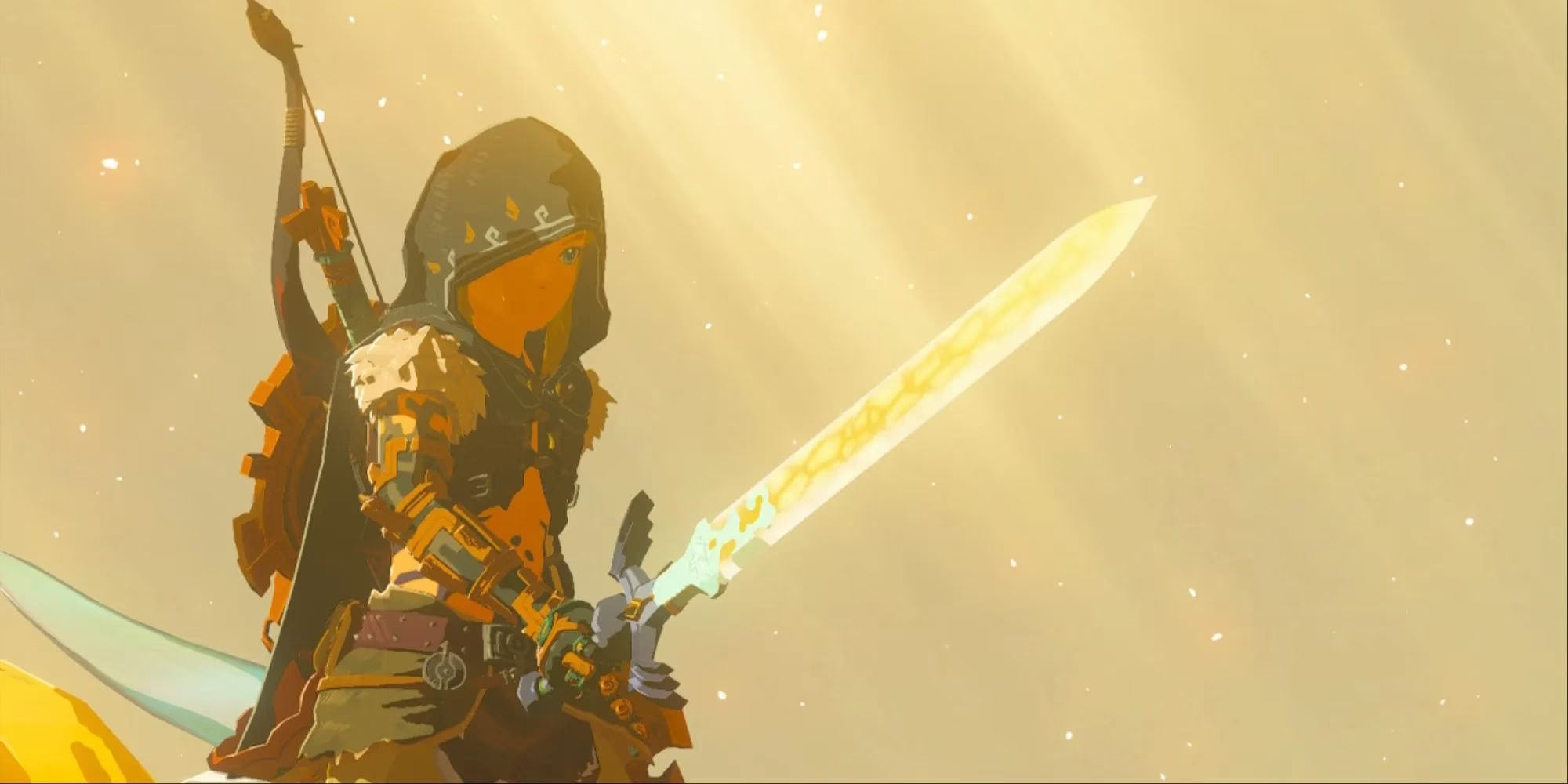
But where do we draw the line between productive friction and plain old annoyance? The weapon-swap lockout is less a sculptor’s tool and more like a single grain of sand in a finely tuned clockwork—imperceptible at first, but capable of seizing the entire mechanism if ignored long enough. It doesn’t teach anything. It doesn’t encourage experimentation. It simply confiscates a few seconds of your life, one menu fumble at a time.
The Dance of the Locked Equip Button
Picture this: you’re in the middle of a chaotic skirmish with a Battle Talus. Bokoblins are tumbling off its shoulders, a storm is rolling in, and your Lizalfos-tail whip just shattered. Instinctively, you pause to grab the sturdy hammer you fused an hour ago specifically for rock-smashing. The D-pad has betrayed you—you need to dive into the quick menu with all the grace of a startled octopus. You scroll past dozens of fused oddities, find your beloved Talus-B-Gone 9000, and press ‘Equip.’
But the option is grayed out.
Link, that stoic hero who has slain Calamities and stared into the eyes of dragons, is still finishing his animation. His left arm is tracing the final, imperceptible arc of the previous swing—a motion that will take perhaps 0.8 more seconds. In that sliver of time, you cannot equip anything. You must exit the menu, wait for his elbow to complete its celestial journey, then wade through selection screens again while the Talus rears back for a boulder toss. It’s the gaming equivalent of pushing a pull door, over and over, while the building burns behind you.
This happens constantly because weapons break constantly. In an average fight against a silver-tier mob, you might go through two or three weapons, meaning you’ll run headfirst into this grayed-out wall at least that many times. The issue compounds when you simply want to switch tactics—say, swapping a heavy two-hander for a spear to poke at an airborne Aerocuda. The game effectively tells you: “Nope, you committed to that clumsy horizontal slash, and you will watch every single frame of its recovery before you are permitted to adapt.”
Why This Hurts More Than It Should
There’s a reasonable argument that Nintendo wants to maintain a sense of weight and deliberation in combat. Tears of the Kingdom isn’t Devil May Cry; you shouldn’t be able to cancel out of a greatsword swing into an electric wand and then juggle enemies like Dante on a caffeine binge. The animations have heft, and that heft is central to the game’s tactile charm. No one is asking for animation-cancelling techniques that would turn Link into a Hyrulean Bayonetta, twirling between weapon types in a blur of Witch Time.
But there is a vast, fertile middle ground between “full character-action madness” and “you must wait for your avatar’s pinky finger to drop a nanometer before the menu acknowledges your existence.” The lockout window is comically oversized, extending well beyond the point where Link’s arm has visually stopped moving. It feels like the game is holding onto the swing with sweaty palms, refusing to let go until a hidden internal timer expires. This isn’t weight—it’s stalling.
Think of it as a conversational tic. You’re having an engaging discussion with a friend, but every time you try to respond, they hold up a finger and say, “Wait, I’m still forming my thought,” even though they’ve been silent for three seconds. The flow disintegrates, not because the thought isn’t worth hearing, but because the rhythm has been shattered by a needless pause. Combat in Tears of the Kingdom is a rhythm, a back-and-forth of flurry rushes, shield parries, and desperate fruit-eating. The equip lockout is a metronome that skips a beat at the worst possible moment.
A Glitch in the Matrix
What makes this all the more maddening is that the game already allows for a deluge of menu action in other contexts. You can instantly scarf down a five-course meal of seared meats while ragdolling down a cliff. You can swap armor sets in the middle of a lightning strike with frictionless ease. Changing a shield or bow during combat? No problem—those slots obey your reflexes. But the weapon that occupies your right hand, the very instrument of your survival, is protected by a ceremonial waiting period usually reserved for bureaucratic paperwork.
Some players have theorized it’s an anti-cheese measure, preventing you from dancing in and out of menus to chain unique weapon abilities. But with Zonai devices letting us construct autonomous death drones and Recall letting us ride fallen rocks back into the sky, it’s hard to believe Nintendo is worried about menu min-maxing. The reality is likely simpler and sadder: it’s an overlooked artifact of animation logic, a holdover from a system built for a console generation that prioritized meticulous motion over instant response. Back in 2017, it was forgivable. In 2023, it was an itch. In 2026, after countless patches and one massive DLC that didn’t address it? It’s a callus.
The Weight of Minor Things
The tragedy of this flaw is that it doesn’t even spark the kind of productive rage that weapon durability inspires. When your sword breaks, you groan, but then you scan the environment for something—anything—to fuse to a stick. That moment of panic often leads to the most memorable stories. The equip lockout, however, offers no such narrative redemption. It’s just a small, joyless vacuum of agency, repeated so often that it becomes a background hum of disappointment.
As the Colorado River carved the Grand Canyon not with violence but with unwavering persistence, so too does this microscopic friction sculpt a canyon of micro-stress in your psyche. You don’t stop playing because of it, but you do carry it with you, a faint but permanent residue on the otherwise luminous experience.
It’s 2026, and the community has long since moved on to arguing about the best way to cheese King Gleeoks or speedrun the Depths with a single fan. But the equip lockout remains, a ghost in the machine that every player will encounter a thousand times across their playthrough. So here’s a belated plea, shouted into the time-worn echoes of the Lanayru Promenade: please, Nintendo, just this once, put away the sandpaper. Let us swap our weapons the moment our hands are empty. Your game is nearly perfect, and this one tiny, stubborn shard of grit is the only thing keeping it from feeling like silk.