In the sprawling, sun-drenched expanse of Hyrule, where the sky islands drift like forgotten memories and the Depths whisper with ancient malice, I found a world of infinite possibility. Yet, as the years have passed since the kingdom's salvation in 2023, a quiet truth has settled upon me, as gentle and persistent as the rain over Hateno Village: the freedom that makes The Legend of Zelda: Tears of the Kingdom so breathtaking can, in time, render its challenges familiar, its dangers predictable. The Demon King's power, once a looming shadow, becomes a known quantity. But what if the greatest challenge in Hyrule was not the one written by its creators, but the one I chose to write for myself? What if the true test of a hero was not in defeating Ganon, but in redefining the very meaning of the journey?
1. The Long Road: Abandoning the Convenience of Fast Travel
The map of Hyrule in Tears of the Kingdom is a living tapestry, vaster than the wilds I roamed in my previous life. Fast travel, that miraculous whisper between shrines and towers, is a blessing for the weary. But to remove it? That is to choose the pilgrimage over the portal. As suggested by a fellow wanderer, to forbid myself from teleportation is to embrace the slog, the beautiful, grueling reality of distance. It elongates the game not just in hours, but in experience. No longer do I simply appear at my destination; I earn my arrival. I learn the contours of every hill, the shade of every copse of trees. This challenge is less about combat difficulty and more about endurance, about the quiet battle against my own frustration. It forces my hand, quite literally, to become creative with Ultrahand, crafting vehicles not for spectacle, but for survival. A simple cart becomes my chariot; a hovercraft, my salvation across a chasm. The journey itself becomes the destination.
2. Grounded: The Weight of a World Without Wings
My paraglider. Oh, how I took it for granted! That canvas wing was an extension of my soul, a piece of the sky I could clutch in my hands. To surrender it is to feel the world grow heavier, more imposing. In this new era, where the very earth has been torn asunder and lifted to the heavens, the paraglider was my safety net, my swift escape from perilous heights. Without it, every cliff face is a prison, every leap an act of faith or foolishness. Navigation becomes a puzzle of its own. I must plan my descents from the Sky Islands with the care of a cartographer, finding slopes and waterways to break my fall. The land reclaims its danger. A misstep from a modest ledge can mean a loss of precious hearts. I realize now how much I relied on that gentle drift; its absence makes me truly feel the scale and the peril of this reborn Hyrule. The wind no longer carries me; I must contend with it.
3. The Herbivore's Burden: A Vegan Link in a World of Plenty
Hyrule is bountiful. Forests teem with game, and rivers are rich with fish. My cooking pot has always been a place of alchemical wonder, transforming meat and spice into powerful elixirs of strength and stamina. But what if I turned away from this plenty? A fellow traveler proposed a vow of veganism: no meat, no animal products. Suddenly, the culinary landscape withers. No more mighty bananas with meat for attack boosts, no simmered fruit for healing. My diet shrinks to foraged greens, mushrooms, and hearty radishes. These restrictions remove a lot of the game’s most potent recipes, forcing me to find strength in simplicity. A simple Vegetable Curry or Mushroom Skewer becomes a cherished meal. This challenge reframes my relationship with the environment. I am no longer a hunter, but a gatherer, living in delicate harmony with the creatures I once saw as resources. It is a quiet, contemplative way to experience the kingdom's ecology.
4. The Weight of Exhaustion: A Stamina Bar That Never Grows
Stamina is the rhythm of life in Hyrule—the gasp for air as I climb, the burning in my legs as I sprint, the tense focus as I draw my bow. We are conditioned to seek out Shrines, to trade their blessings for a sliver of a green wheel. But what if I refused this growth? To play with only the base stamina is to accept a profound limitation. I won’t be able to climb or glide as far, making every mountain a strategic puzzle. A cliff that was once a quick ascent becomes a multi-stage ordeal, a search for resting ledges. Combat, too, changes. Flurry rushes and evasive sprints are precious, finite resources. I must choose my movements with the precision of a swordsman in a duel to the death, for a wasted dash could leave me vulnerable. This challenge teaches economy of motion and a deep respect for the landscape's verticality.
5. The Realistic Satchel: Carrying Only What I Can Hold
Look at me. A simple tunic, a small satchel at my hip. Realistically, how much could I possibly carry? A dozen swords? Fifty apples? A hundred Zonai devices? The idea is laughable. Inspired by this simple truth, I adopted a rule of realism for my inventory. I may carry only what would logically fit: perhaps a single sword on my back, a bow, a shield, and a handful of items in my pouch. No stockpiling of different types of weapons, no hoarding of gems or monster parts. This transforms Hyrule into a true scavenger's world. Every encounter is fresh. I must use the weapon I find, or leave it behind. It makes the search for the legendary, unbreakable Master Sword not just a quest, but a desperate need for stability in an ephemeral world. The anxiety before a major fight is palpable—have I prepared enough, or am I walking to my doom with just a stick and a dream?
6. The Survivalist's Code: Eat, Sleep, and Live as Link Would
Tears of the Kingdom does not demand that I eat or sleep to survive. But what if I imposed those mortal needs upon myself? This challenge, expanding on the no-fast-travel rule, turns the adventure into a survival simulation. I need to eat regularly and sleep once a night (simulated by resting at a campfire until morning). Suddenly, my goals for each in-game day shift. It is not just "find the next dungeon," but "find food before sundown and a safe place to rest." Hunting and foraging become daily rituals. A rainy night becomes a genuine hazard, forcing me to seek shelter. This playthrough grants me a visceral, grinding appreciation for Link's journey. I feel the weight of his mission, compounded by the basic, human need for sustenance and safety. The world feels more alive, and more indifferent to my heroics.
7. The Three-Heart Tradition: A Dance on the Razor's Edge
Ah, the classic three-heart challenge—a rite of passage for Zelda devotees. While Tears of the Kingdom forces a fourth heart upon me early on, the spirit of the challenge remains. I can either play pretending that fourth heart is a phantom, succumbing to any blow that depletes my third, or I can seek out the mysterious, grim Bargainer Statues in the Depths. There, I can sell a heart container, literally trading my vitality for a curse, to return my life force to the sacred trio. Every enemy is a lethal threat. A Red Bokoblin's club, a Keese's glancing bite—any could be my end. It reduces combat to a flawless ballet of parries and dodges. There is no room for error. It is the purest form of the hero's test, where courage is measured not in strength, but in perfect, unwavering focus.
8. The Fool's Errand: Facing the Demon King Unprepared
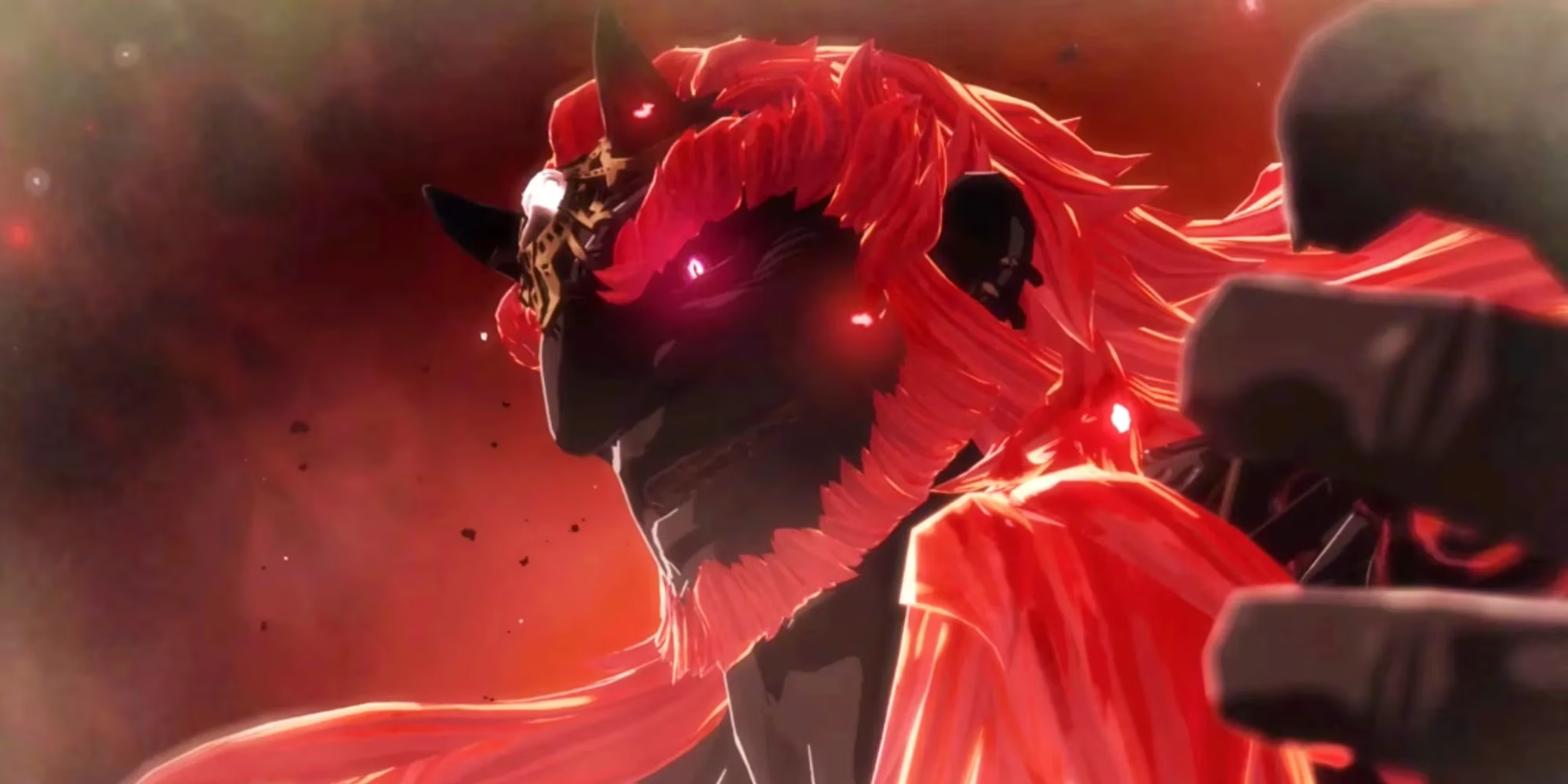
The game, in its boundless generosity, sets me free after the Great Sky Island and says, "Go." It does not say I must be ready. And so, the most audacious challenge calls: go to him. Go to Ganondorf now. With my basic clothes, my unupgraded slate, and my three hearts, I would embark on a perilous pilgrimage to the Hyrule Castle Chasm—without my paraglider to ease the descent. Then, in the gloom, I would face the final boss of the game without any additional hearts, stamina, or powerful gear. It is the ultimate test of skill, a gauntlet run from the first moment to the last. Could I, with nothing but my wits and the Master Sword I hope to claim along the way, stand against the embodiment of hatred? It is the quickest path to the end, and potentially the most humbling.
9. The Architect's Limitation: A World Built Only of Logs
The Zonai arm gifted me the power of creation. I could build marvels: flying machines, death robots, intricate puzzle solutions. But what if I limited my palette to the most humble of materials? The common log. This challenge forces a primitive ingenuity. I must use logs for a decent amount of the game’s puzzles, crafting rafts, bridges, and rudimentary levers. It is a return to basics, stripping away the flashy Zonai technology to focus on fundamental physics and problem-solving. A puzzle that could be solved with a fancy rocket shield must now be tackled with rolling logs and careful balance. It makes me see the world's resources in a new light, appreciating the simple strength of wood and rope.
10. The Cartographer's Blank Slate: Navigating by Landmark and Memory
Finally, the most immersive challenge of all: I reject the Skyview Towers. I leave my map a blank parchment, a terra incognita. In this vast world, I must navigate by the sun, by the stars, by the unique shape of a distant mountain or the memory of a peculiar tree. Getting lost is not a failure; it is part of the experience. I learn Hyrule not as a series of icons on a screen, but as a living, breathing place with its own landmarks and logic. The journey to Zora's Domain becomes an exercise in following river currents; finding Gerudo Town requires tracing the desert's star-lit dunes. Players who tackle Tears of the Kingdom this way will end up knowing Hyrule better than most. It is the challenge that most deeply connects me to the land I am sworn to protect.
In 2026, years after its release, The Legend of Zelda: Tears of the Kingdom continues to offer not just a game, but a canvas. The difficulty is not a fixed setting, but a philosophy. By weaving these self-imposed rules into the fabric of my journey, I do not just play the game—I converse with it. I ask it new questions, and it reveals new, often more profound, answers. The true kingdom I explore is not just Hyrule, but the limits of my own patience, creativity, and resolve. And in that personal, poetic struggle, I find a hero's journey that feels uniquely, eternally, my own.