I’ve spent hundreds of hours navigating Hyrule’s skies, and I thought I’d seen every possible flying machine the Zonai devices could stitch together. Then I stumbled upon a construct so outrageous it felt like watching a fish sprint across the desert. Back in 2023, a player named chesepuf uploaded footage of a strange-looking aircraft that wasn’t just fast—it shattered every expectation, hitting a jaw-dropping 90 meters per second. That’s over 201 miles per hour in a game where most vehicles chug along like sleepy bumblebees. Even in 2026, three years after the launch of The Legend of Zelda: Tears of the Kingdom, this creation remains a high-water mark of community engineering, a testament to how players can bend a game’s rules like a blacksmith reshaping molten steel into something entirely unintended.
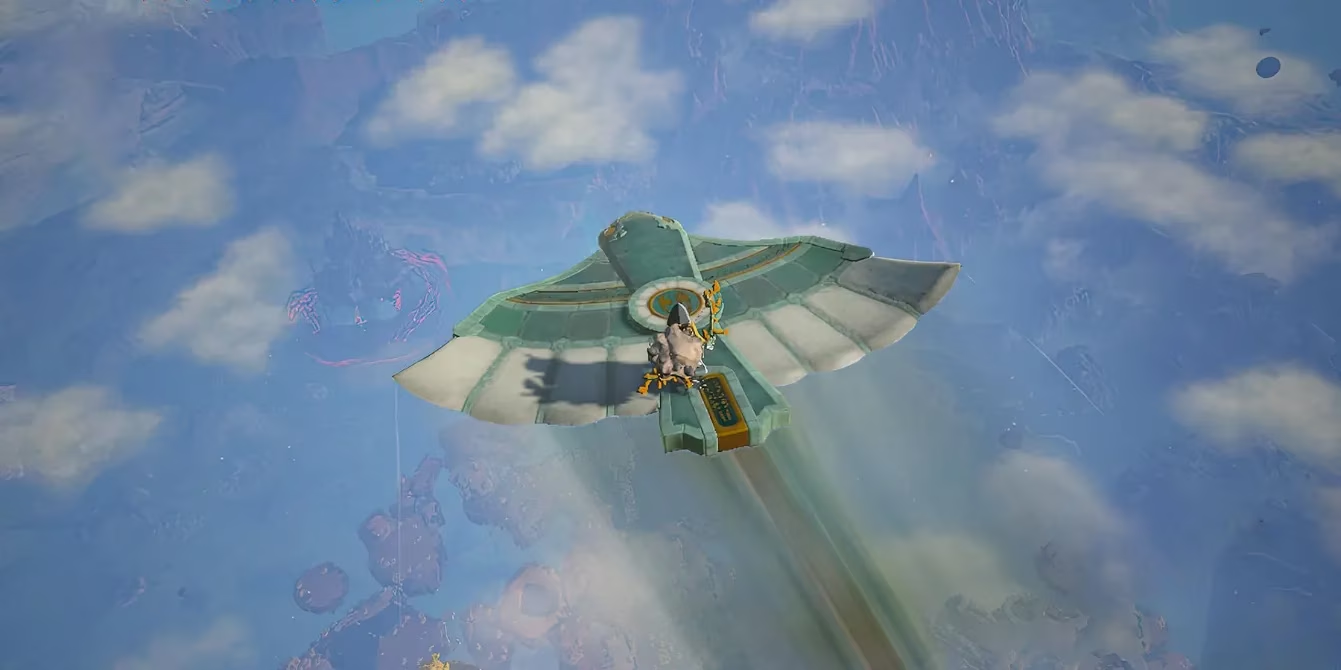
The core of this speed demon lies in two almost poetic design choices. First, the tail end features a guard rail salvaged from the Construct Factory, which happens to be the lightest known material in the game—so ethereal that gravity barely notices it, like a dandelion seed caught in a thermal. But the real magic is the unattached Zonai fan trapped inside a cage of slates at the front. Normally, a fan pushes air backward and gets pushed forward itself; Newton’s third law works as reliably in Hyrule as it does on Earth. However, a free-floating activated fan doesn’t exert force on itself, effectively turning into a one-way thruster that shoves its surroundings without dragging its own mass. Imagine a sailboat propelled by a ghostly wind that blows against the sails but never buffets the hull—pure momentum with no appetite for balance. That’s the loophole chesepuf seized.
To make this contraption pilotable, the inventor had to solve a second puzzle. At such extreme velocity, the steering stick normally yanks Link off the controls once you cross roughly 100 miles per hour. The solution was a glitched Steering Stick—dubbed the “ultrabroken stick” by the community—which disables the ejection trigger but also loses the ability to actually steer. By attaching a second, functional Steering Stick to the front and a rear-mounted fan for maneuvering, the plane became remotely controllable while preserving the cockpit’s immunity to speed limits. It’s like building a car with a steering wheel that doesn’t connect to the axle but still somehow obeys your will through a series of whisper-thin linkages.
Sadly for anyone itching to replicate this exact blueprint, Nintendo patched the ultrabroken stick glitch in update 1.2.0 back in July 2023. That means an up-to-date version of the game won’t allow you to craft this exact model. However, the spirit of discovery it ignited hasn’t dimmed. In the years since, I’ve watched the community turn toward modded emulators and unpatched cartridges to preserve such oddities, and new glitches constantly bubble up like air pockets in a swamp. The speed itself was calculated by tracking the mini-map coordinates in the original footage—a method that requires no special tools, just a sharp eye and patience. Even now, players dissect each frame to tease out physics anomalies that Nintendo’s designers probably never dreamed of.
What fascinates me most is how a funny-looking assembly of rails, fans, and slates can become a monument to collective creativity. It’s not just about breaking speed records; it’s about the thousands of hours of trial and error, the late-night theory-crafting sessions, and the delight when a prototype first lurches forward instead of exploding. I remember building my own clumsy versions of jets and helicopters during the game’s launch month in 2023, and each wobble taught me something new about Hyrule’s invisible scaffolding of rules. This 200-mph plane feels like the climax of that learning curve, a proof that even a single-player masterpiece can sustain an endless cooperative research project.
Looking at Tears of the Kingdom through a 2026 lens, it’s clear that Nintendo created more than a game; they built a sandbox where the only true limit is imagination—and sometimes a patch note. The guard rail’s weightlessness and the unattached fan’s disregard for Newton are now legendary among builders, and new players still stumble upon these artifacts with the same awe as archaeologists uncovering a lost colossus. I’ve seen entire forums dedicated to resurrecting pre-patch wonders or discovering fresh exploits in the latest updates. The aircraft that chesepuf birthed is more than a YouTube clip; it’s a symbol of how we, as players, can turn a toy box into a laboratory, sculpting moments that blend engineering rigor with sheer magical absurdity. And honestly, I wouldn’t have it any other way.