I never expected a simple self-imposed challenge to become one of the most exhilarating gaming experiences of my life. Most players in The Legend of Zelda: Tears of the Kingdom follow a relatively straightforward path—descend from the Great Sky Island, grab the paraglider from Purah, and then slowly unravel the mysteries of Hyrule. But a question kept nagging at me after my first playthrough: what if I refused to touch the surface world entirely? Could I still claim the legendary Master Sword, the weapon that seals the darkness, without ever setting foot on the ground or using the paraglider?
You might think it's impossible. After all, the Light Dragon that carries the sword flies at an absurdly high altitude until you find all 11 Geoglyphs. On top of that, pulling the blade from its head requires two full stamina wheels—that's at least 20 Shrines‘ worth of Light of Blessings. And how do you travel between those sky islands without a paraglider to soften your falls? These hurdles only made the idea more irresistible to me.
The Rules of Engagement
I set my boundaries from the very first moments of a fresh save file:
-
Never touch Hyrule’s surface. The Sky Islands and the depths accessible from them were fair game, but the golden fields below were off-limits.
-
No paraglider. Since you get it by completing a quest in Lookout Landing after your first dive, this single decision locked me out of the glider forever.
-
Obtain the Master Sword before any major story progression that would lower the Light Dragon.
Why do this? The game’s open-ended design practically begs for such experiments. Tears of the Kingdom has been out for three years now, and the community has proven time and again that the only limits are your creativity. I wanted to push that philosophy to its extreme.
Building the Foundation
My first challenge was stamina. Without descending, I could only explore the Great Sky Island and a handful of smaller island clusters reachable via Zonai Wings. Every Shrine I completed meant one more Light of Blessing. But here’s the catch: many Shrines require traveling across gaps, climbing, or fighting Constructs—all without the safety net of a paraglider. I quickly learned that fall damage would be my constant enemy.
That’s where fairies came in. Each one serves as an automatic revive upon lethal damage, and I needed a lot of them. I spent hours carefully navigating the edges of sky lakes to catch them, often having to reload saves when a misstep sent me plummeting into the void. It was tedious but oddly meditative. Eventually I stockpiled about a dozen, which would prove essential during my aerial expeditions.
To reach Shrines scattered across the archipelago, I relied heavily on Zonai devices. Wings let me glide between islands, but without a paraglider I couldn’t simply bail out mid-flight if something went wrong. I built elaborate flying machines with fans, carts, and balloons—sometimes resulting in comical failures that sent me spiraling back to the last fairy checkpoint. But through trial and error, I completed the required 20 Shrines and obtained my second stamina ring.
The Hunt for the Light Dragon
Now came the true test. With the Geoglyphs untouched, the Light Dragon cruises at nearly 3,000 meters above sea level, far above the highest Sky Island. Finding it was a game of patience. I stationed myself on the highest points of the Great Sky Island and scanned the horizons with the scope, sometimes waiting in real-time for the creature to pass within reach. The dragon’s path is a massive loop that takes it over the sky islands twice per cycle, but catching it required building a craft capable of ascending and intercepting it at speed.
This is where my stockpile of Zonai capsules paid off. I designed a rocket-powered wing platform: two fans for lift, a wing for control, and multiple rockets for a vertical boost. Timing the launch as the dragon approached, I’d fire the rockets and angle upward. More often than not, I’d miss, or the machine would despawn at the worst moment. But when everything aligned, I’d slam into the dragon’s back, grabbing its smooth scales and holding on for dear life.
The Moment of Truth
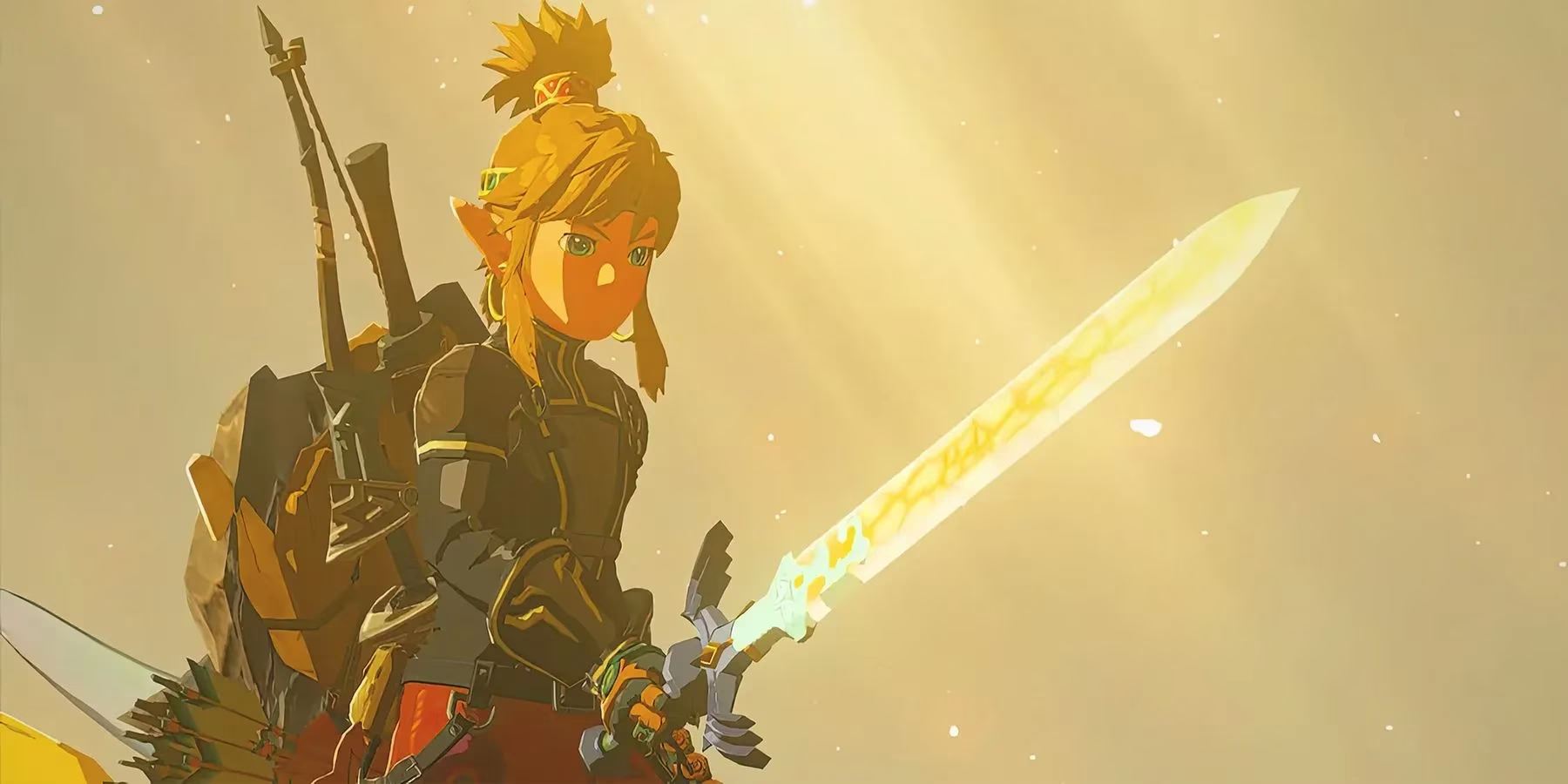
Walking along the Light Dragon’s spine, with the swirling winds howling around me, was surreal. Because my stamina was exactly two wheels, I had no room for error—if I lost grip during the pull-and-struggle sequence, I’d fall into the clouds without a fairy to save me (since touching the sword triggers a special animation that bypasses normal revival). I steadied my breath, pressed the button, and watched the Master Sword slowly slide free. The blade shone, and for a split second I forgot this was just a game.
What strikes me most about this experience is that Nintendo never intended anyone to play this way. Yet the developers’ commitment to player freedom made it not only possible but deeply rewarding. It makes you wonder: how many other “impossible” paths are hidden in Tears of the Kingdom, just waiting for someone stubborn enough to try?
Reflections
This journey took me roughly 40 hours, countless fairy revivals, and more Zonai prototypes than I can count. Afterward, I finally let Link touch the ground—but only after the Master Sword was already on his back. The feeling of accomplishment still lingers. If you’re looking for a fresh way to experience this masterpiece, I’d encourage you to set your own bizarre rules. You might just discover something magical.
Tears of the Kingdom remains a testament to what open-world design can achieve when it trusts its players. And as for me? I’ll never look at a fairy the same way again.