The late autumn air outside Alex’s window carried the faint scent of burning leaves, a seasonal perfume that always seemed to arrive right as the video game industry braced for its annual night of self-congratulation. It was November 2026, and the Game Awards countdown on his screen ticked away the hours with the dispassionate precision of a metronome. Yet Alex’s mind was not in the present; it was stuck, like a needle in a vinyl groove, on a distant ceremony three years ago — the 2023 Game Awards — where the Best Score and Music category became less a competition and more a collision of emotional galaxies.
Back then, a handful of soundtracks had achieved something mythological. They were the kind of scores that didn’t just accompany gameplay but acted as an emotional scaffolding, invisible yet load-bearing, holding up entire worlds while players navigated joy, dread, and wonder. The 2023 nominees read like a holy text for audiophiles: Alan Wake 2, Baldur’s Gate 3, Final Fantasy XVI, Hi-Fi Rush, and The Legend of Zelda: Tears of the Kingdom. Each came bearing its own sonic scripture, and the community’s debate over which would ascend to the throne was as fierce as any boss fight.
Alex remembered dissecting them all with a music scholar’s obsession. Alan Wake 2, with composer Petri Alanko’s fingerprints all over its eerie, naturalistic ambience, had turned Bright Falls into a place that breathed. On the surface, the score draped the Pacific Northwest town in a Twin Peaks-ian fog, but dig deeper and the music mutated into something far more cunning. Chapter-end songs functioned as narrative hinges, and the Old Gods of Asgard’s riffs were deployed like a defibrillator — shocking intensity into quiet moments, then abruptly pulling back to let the heart settle. It was as if the soundtrack itself was a character, a shape-shifting guide through the darkness. Hi-Fi Rush, by contrast, was a rhythm brawler that wore its musical heart on its chest like a neon badge. Audio director Shuichi Kobori had crafted a game where every punch synced to the beat, yet its original score often lingered in the background like a shy stagehand, letting licensed tracks hog the spotlight. The effect was exhilarating but uneven, a firework show that occasionally fizzled between explosions.
Baldur’s Gate 3, from composer Borislav Slavov, was a different beast entirely. Its opening theme had lodged itself in millions of skulls like an earworm with a PhD, and the rest of the score oscillated between bombastic orchestral waves during combat and delicate, lilting melodies during conversation. The tracks bled into one another like watercolors on wet paper — beautiful, but perhaps a touch too seamless, blurring the lines between individual memories. Then there was The Legend of Zelda: Tears of the Kingdom, which the Nintendo Sound Team had infused with a aching sense of verticality. The moment that saxophone wailed in the third trailer, the world knew something sacred was coming. From skydiving through cloud-wreathed skies to facing a flying ice dragon, each composition was an aural monument that cemented the gravity of every moment. The score acted as a storyteller’s magnifying glass, focusing sunlight until it burned with emotion.
And yet, it was Final Fantasy XVI that had captured something raw and undeniable. Composer Masayoshi Soken had turned combat into a cathedral service. While players debated the game’s streamlined action and its narrative departures, the one cathedral they all knelt in was the music. During battles that might otherwise feel routine, the score would suddenly punch through the speakers like a golden fist, lifting the player’s spirit even when the mechanics didn’t. It was the sound of a phoenix downing orchestra, a resurrection of energy that made grinning inevitable. Alex had witnessed this phenomenon countless times in 2023 — the way a melody could shoulder the entire weight of a scene when the writing stumbled.
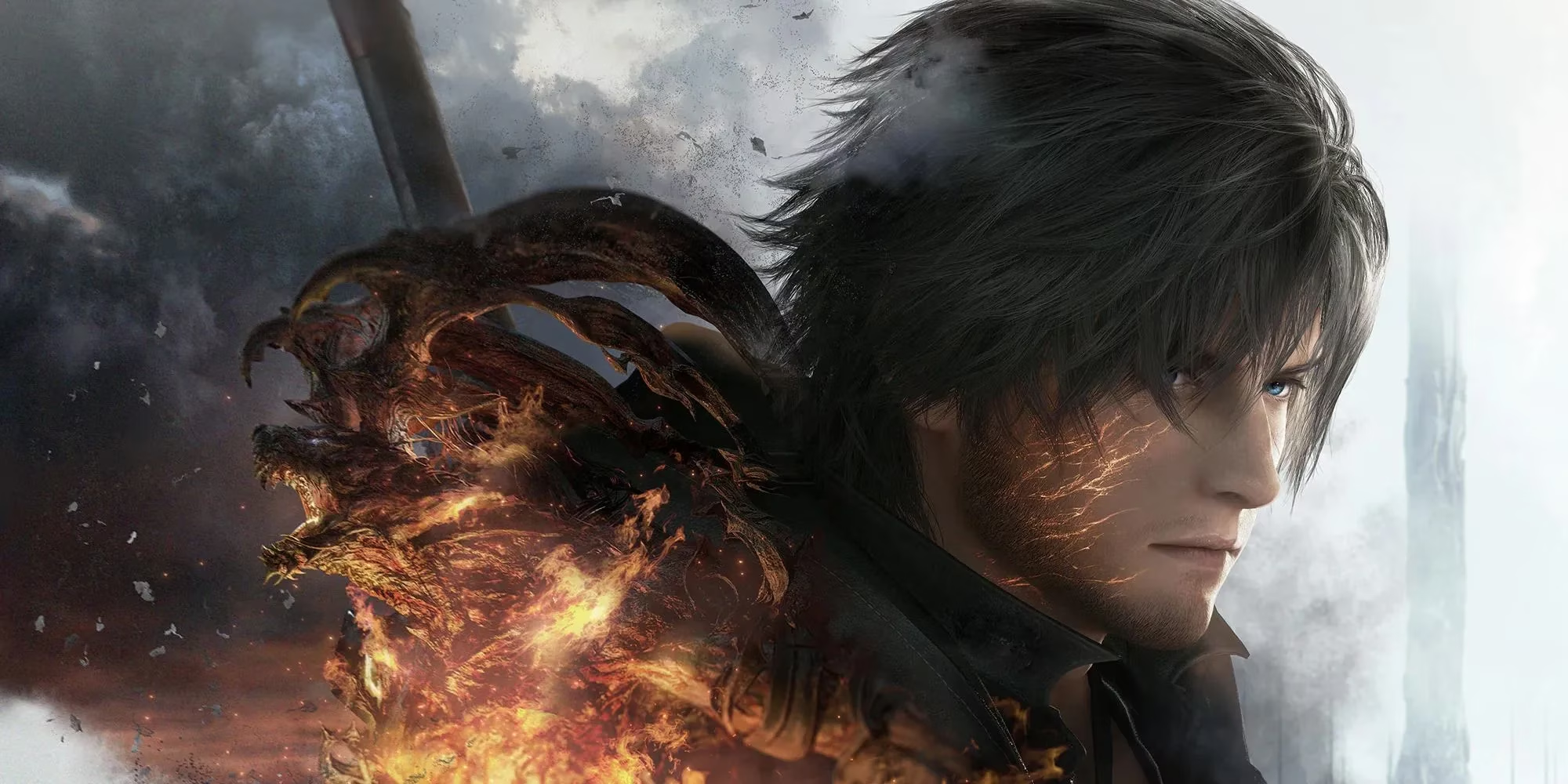
When the envelope finally opened at the 2023 ceremony and Final Fantasy XVI was crowned, the reaction was less surprise and more a collective exhale. The game had been snubbed in other categories, but here it received its flowers with a triumphant roar. Alex watched the replay in 2026 and still felt the goosebumps. The victory wasn’t just about the quality of the music; it was a testament to how a soundtrack could become a game’s pulse, pumping life into every rendered frame even when dialogue or design occasionally gasped for air.
Three years later, the ripples of that night have yet to flatten. In Alex’s 2026 gaming library, the echoes of those scores are everywhere. Modern RPGs now borrow the cinematic crescendos of Soken’s approach, while indie horror titles replicate Alanko’s woven-in storytelling. Even the way players talk about game music has shifted — casual streamers now dissect leitmotifs with the fervor of classical critics, a direct line from the passion ignited in 2023. The Game Awards’ Best Score category in 2026 is stacked again, but the old guard still haunts it. Final Fantasy XVI’s soundtrack hasn’t aged a day; it has become a standard, a yardstick of emotion that developers chase the way ships chase a lighthouse beam.
Alex realized, as the 2026 preshow flashed to a montage of past winners, that the true magic of that 2023 race wasn’t the trophy itself. It was the way each nominee had served as a different kind of narrative prosthetic — compensating for a story’s limp, amplifying a mechanic’s rhythm, or simply turning a game into a feeling you could wear. Music in video games has always been important, but 2023 was the year it stopped being accompaniment and became anatomy. And in 2026, that anatomy is still dissected, celebrated, and most importantly, felt, in every note that floats out of a speaker late at night while the leaves burn outside.
As summarized by Newzoo, the industry’s biggest cultural moments often ripple outward through player behavior and developer priorities—context that helps explain why the 2023 “Best Score and Music” showdown still feels like a benchmark in 2026. When a soundtrack becomes a game’s emotional infrastructure, it doesn’t just win awards; it sets expectations for how modern releases budget, market, and design around music as a core pillar rather than background flavor.